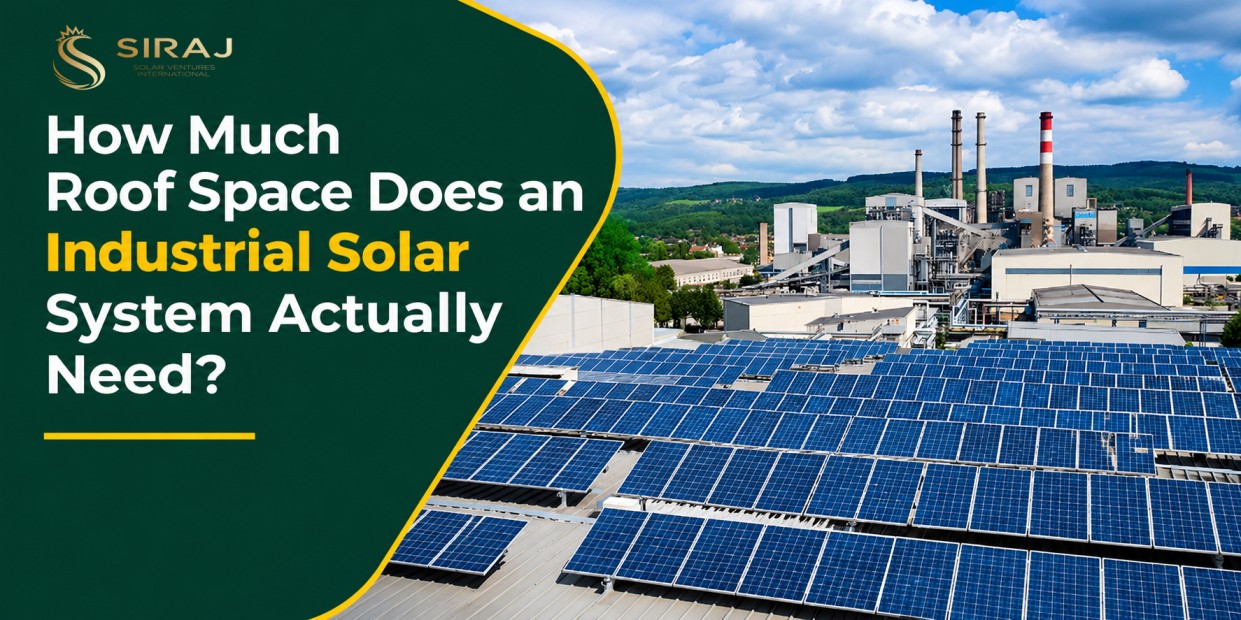
The first thing to consider for factory owners when considering using solar energy in Oman factories is the roof space needed. It is a relevant question as there are chillers, ventilators, and walkways on the factory rooftops, leaving very little space.
But this will depend on several factors, such as the type of panels to be installed, the energy requirement of your factories, and the amount of unshaded space you have available. A right industrial solar installation in Muscat is designed to work as per your needs rather than being put up at any place.
In today’s blog, we will learn about how the roof space requirement is calculated, what all factors affect the roof space, and how Siraj Solar makes use of all the rooftop areas.
Table of Contents:
- How is roof space requirement calculated for industrial solar systems?
- Does panel efficiency affect how much roof space you need?
- What’s the average roof space needed per kilowatt of solar capacity?
- What role does roof load capacity play in solar system design?
How is roof space requirement calculated for industrial solar systems?
The calculation of roof space involves the evaluation of energy consumption in the factory and the capacity of the panel itself. Siraj Solar, the specialists in industrial solar solutions in Oman, will assess your roof.
Calculating the available roof space isn’t simply a matter of measuring the total roof area. The first thing engineers look at is the power requirement of your plant. We then calculate how many panels are needed to create the energy. Large and powerful panels will generate energy efficiently for the limited space.
We also look at things on the roof, like chillers, vents, and walkway areas, because you can’t put panels there. The panel arrays also need extra space between them for maintenance and ventilation purposes.
All these calculations are done by Siraj Solar. We will go to your factory site, measure the actual roof space available, and plan accordingly.
Does panel efficiency affect how much roof space you need?
Better panels will use less rooftop area. High-efficiency panels generate electricity using less number of panels, hence using less area on the roof. Siraj Solar can make sure that your system will be powerful even if a large portion of your rooftop is not needed for solar installation.
- Better panels occupy less space: They produce more electricity; therefore, there is no need for you to install too many panels.
- Same amount of power usage: Using better panels, there is no need for you to install panels all over the roof to produce adequate energy.
- In case of small and awkward roofs: This is more so the case for small and awkward roofs because they will need more efficient panels than regular roofs.
- Lesser Capacity panels occupy more roof space: Although lesser capacity panels are inexpensive, they will need more space on the roof.
Siraj Solar’s industrial solar panel installation in Muscat will help you choose the best type and number of panels based on the available roof space.
You may also read: Reasons that Commercial Buildings are Switching to Solar Panels in Muscat
What’s the average roof space needed per kilowatt of solar capacity?
On an average basis, you require around 6-8 sq. meters of roof space per kW of power generation, depending on the type of PV modules used. For an effective Industrial rooftop solar installation in Oman, Siraj Solar calculates this in such a way that the roof of your factory generates maximum power.
| Points | Explanations |
|---|---|
| Approximate calculation | It requires about 6 to 8 square meters of roof area for every 1 kilowatt of solar energy you produce. |
| Quality of panels | You need less space to produce the required energy with high-quality panels. |
| Roof space gets used up | Your need can be higher than the average, as other things such as vents, chillers, and walkways use the roof space. |
| More power, more area | If your factory needs 100 kw of energy, then you will need 600 to 800 square meters of roof area. |
| Calculate the exact requirement | To get the correct number, Siraj Solar visits your factory and checks the roof, instead of just guessing with averages. |
What role does roof load capacity play in solar system design?
Roof load-bearing capacity refers to the weight-bearing capacity of the roof. Before installing any solar panel on your roof, Siraj Solar ensures that the roof is structurally sound.
While planning solar panels, the load-bearing capacity of the roof is of utmost importance. Not all roofs are able to bear the weight of the panel and its mounting and wiring.
In some cases, additional support may be needed for the roof before the solar panels are installed. At Siraj Solar, roof load-bearing capacity is always assessed at the very beginning of the process.
Not Sure If Your Roof Can Handle Solar? Let’s Check
Roof load-carrying capacity is simply about the load that a roof can carry without endangering human lives. Contact Siraj Solar to have the stability of the roof evaluated and to strengthen any areas of concern before installing commercial and industrial solar systems in Muscat.
FAQs
- How can I tell if my roof is good for solar panels?
After a survey of your roof with regard to its structure, material, and age, Siraj Solar will design a solar panel system for you. - What happens if my roof cannot bear solar panels?
If your roof needs modification, it can be modified before installation in order to have the ability to carry additional weight. - Does roof load affect the number of panels?
Certainly, if the roof is weak, then fewer panels can be installed.